
ISO 42001 Requirements Explained: A Complete Guide to AI Management Systems
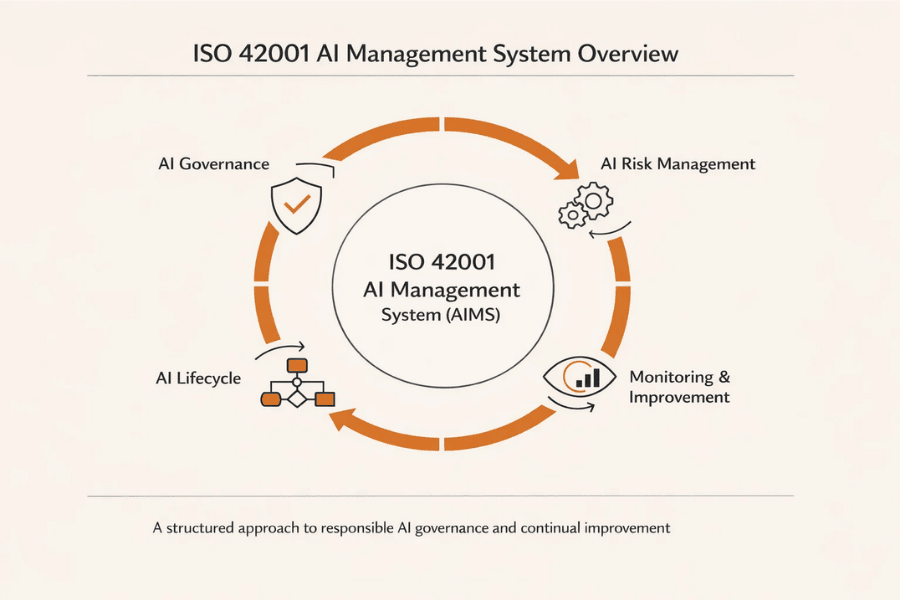
As artificial intelligence becomes more embedded in everyday business operations, organisations are under increasing pressure to manage it responsibly. This is where ISO 42001 comes in. It is an international standard designed to help organisations establish, implement and improve an AI management system (AIMS). In simple terms, it provides a structured way to govern how AI is developed, deployed and monitored.
Unlike purely technical standards, ISO 42001 focuses on the broader picture. It brings together AI governance, risk management and ethical considerations, helping organisations ensure their AI systems are not only effective, but also trustworthy and aligned with expectations from regulators, customers and society.
To understand how the standard works in practice, it helps to break down a few key concepts.
- An AI Management System (AIMS) is the framework organisations use to manage AI responsibly. It includes policies, processes and controls that guide how AI systems are built and used.
- AI governance refers to the structures and oversight needed to ensure AI is used in a controlled and accountable way. This includes leadership involvement, clear decision-making and defined responsibilities.
- AI risk management focuses on identifying and reducing potential harms, such as bias, lack of transparency or unintended consequences. It ensures organisations can anticipate issues rather than simply reacting to them.
- The AI lifecycle covers the full journey of an AI system, from design and development through to deployment, monitoring and eventual retirement. ISO 42001 encourages organisations to manage risk and performance at every stage.
Taken together, these elements form the foundation of ISO 42001 requirements. They help organisations move from ad hoc AI use to a more structured, reliable approach. To do this effectively, however, organisations first need to understand their own context and the stakeholders involved.
Understanding Your Organisation’s AI Context and Stakeholders

Before putting controls and processes in place, organisations need a clear understanding of where and how AI fits into their environment. AI governance does not happen in isolation—it is shaped by business goals, regulatory pressures and the expectations of those affected by AI systems.
Understanding your organisation’s context
This means identifying the internal and external factors that influence how AI is used. Internally, this could include business strategy, existing technology and the types of AI applications being developed. Externally, it involves industry standards, legal requirements and market expectations. Together, these factors determine how complex your AI management system needs to be.
Identifying interested parties
Interested parties are the individuals or groups affected by your AI systems. This typically includes customers, employees, regulators, partners and, in some cases, wider society. Each group may have different concerns, from data privacy and fairness to transparency and reliability. Recognising these perspectives is essential for building trust.
Understanding expectations and obligations
Once stakeholders are identified, organisations need to understand what is expected of them. This includes regulatory compliance, ethical responsibilities and contractual commitments. Meeting these expectations is not just about avoiding risk—it also strengthens credibility and long-term relationships.
Defining the scope of your AI management system
The scope sets the boundaries of your AI management system. It defines which AI systems, processes and business areas are included, and which are not. A clearly defined scope ensures that efforts are focused and that responsibilities are understood across the organisation.
By taking the time to understand context and stakeholders, organisations create a solid foundation for everything that follows. The next step is ensuring that leadership provides the direction, accountability and governance needed to make it all work in practice.
Leadership Responsibilities and AI Governance

Effective AI governance starts at the top. Without clear leadership and direction, even well-designed processes can fail to deliver consistent results. ISO 42001 places strong emphasis on the role of senior management in shaping how AI is managed across the organisation.
Leadership and accountability
Top management is responsible for ensuring that the AI management system is established, maintained and aligned with organisational objectives. This includes setting priorities, allocating resources and ensuring oversight of AI-related risks. Accountability at this level signals that AI governance is a business-critical issue, not just a technical concern.
Establishing an AI policy
An AI policy provides a clear statement of intent. It outlines how the organisation approaches AI, including its commitment to responsible use, compliance and continuous improvement. The policy should align with broader business goals and act as a reference point for decision-making across teams.
Clear ownership is essential for effective AI governance. Organisations need to define who is responsible for what, from development and deployment to monitoring and risk management. This reduces ambiguity and ensures that decisions are made by the right people at the right time.
Embedding responsible AI culture
Governance is not only about structures and policies—it also depends on behaviour. Organisations need to promote awareness of AI risks and responsibilities at all levels. This may involve training, internal communication and encouraging a culture where concerns can be raised openly and addressed constructively.
When leadership, structure and culture are aligned, organisations are better positioned to manage AI in a consistent and accountable way. From here, the focus shifts to turning that direction into clear objectives and practical plans.
Setting AI Objectives and Planning for Success

Once leadership and governance structures are in place, organisations need to turn direction into action. This is where ISO 42001 requirements move from high-level intent to practical implementation. Clear objectives and structured planning ensure that AI initiatives are aligned, measurable and manageable over time.
Setting meaningful AI objectives
AI objectives define what an organisation wants to achieve with its AI systems. These should be closely linked to business goals, such as improving efficiency, enhancing customer experience or reducing risk. At the same time, they need to reflect the organisation’s risk appetite and commitment to responsible AI practices. Well-defined objectives provide clarity and help teams focus on outcomes that matter.
Planning actions to achieve objectives
Once objectives are set, organisations need to map out how they will be achieved. This involves defining specific initiatives, assigning responsibilities and establishing timelines. Progress should be tracked through measurable indicators, ensuring that plans remain on course. Without this structure, even strong strategies can lose momentum.
Addressing risks and opportunities early
Planning is not just about achieving positive outcomes—it also requires anticipating potential challenges. Organisations should consider both the risks and opportunities associated with AI from the outset. This balanced approach ensures that innovation is encouraged while potential harms are identified and managed early.
Managing changes to AI systems
AI systems are rarely static. Models are updated, data evolves and new use cases emerge. Managing these changes in a controlled way is essential to maintaining performance and trust. This includes documenting updates, validating changes and assessing their impact before implementation.
With clear objectives and structured plans in place, organisations are better equipped to manage the uncertainties that come with AI. This naturally leads to a deeper focus on identifying and managing risks and opportunities.
Identifying and Managing AI Risks and Opportunities in ISO 42001

At the heart of ISO 42001 is a strong emphasis on risk management. An effective AI risk management framework allows organisations to understand potential issues, reduce harm and make informed decisions about how AI systems are used. At the same time, it ensures that opportunities are not overlooked.
Understanding AI risks
AI systems can introduce a range of risks if not properly managed. These may include biased outputs, lack of transparency, security vulnerabilities or unintended misuse. In some cases, risks can affect not only the organisation but also customers and wider society. Recognising these risks is the first step towards controlling them.
Identifying opportunities
Alongside risks, AI offers significant opportunities. It can improve efficiency, support better decision-making and enable innovation across industries. A balanced approach to ISO 42001 requirements means considering both sides—maximising value while maintaining control.
Risk assessment in practice
An ISO 42001 risk assessment involves evaluating both the likelihood of a risk occurring and its potential impact. This helps organisations prioritise which risks need immediate attention and which can be monitored over time. Practical assessment methods often combine technical analysis with business judgement.
Risk treatment and mitigation
Once risks are identified and assessed, organisations need to decide how to address them. This may involve implementing controls, introducing human oversight or adjusting how AI systems are used. Ongoing monitoring is essential to ensure that these measures remain effective as systems evolve.
Managing risks and opportunities effectively requires more than just processes; it depends on having the right people, skills and resources in place. This is where support functions play a critical role.
Building the Right Resources, Skills and Awareness

Even the most well-designed AI governance framework will struggle without the right support behind it. ISO 42001 highlights the importance of ensuring that organisations have the resources, capabilities and awareness needed to manage AI effectively.
Providing adequate resources
Organisations need to allocate sufficient resources to support their AI management system. This includes skilled personnel, appropriate technology, high-quality data and the necessary budget. Without these foundations, it becomes difficult to implement controls or maintain performance over time.
Ensuring competence and skills
AI management requires a combination of technical, ethical and legal expertise. Teams need to understand not only how AI systems work, but also their potential risks and implications. Ongoing training and development help ensure that staff remain capable of managing AI responsibly as technologies evolve.
Raising awareness across the organisation
Responsible AI is not limited to specialist teams. Employees at all levels should have a basic understanding of how AI is used within the organisation and what their responsibilities are. This broader awareness supports better decision-making and helps prevent issues from being overlooked.
Effective communication
Clear communication is essential both internally and externally. Internally, teams need to share information about AI systems, risks and performance. Externally, organisations may need to provide transparency to customers, regulators and other stakeholders. Open communication builds trust and supports accountability.
Managing documented information
Documentation is a key part of ISO 42001 requirements. Organisations need to maintain clear records of policies, processes and activities related to their AI systems. This not only supports consistency and auditability but also makes it easier to review and improve the system over time.
With the right resources, skills and awareness in place, organisations are better prepared to operate and control their AI systems effectively, ensuring that governance and risk management translate into real-world outcomes.
Putting AI Systems into Operation and Control

Once objectives are defined and the right support structures are in place, organisations need to ensure their AI systems are operated in a controlled and consistent way. This is where strategy turns into day-to-day execution. ISO 42001 compliance depends not just on planning, but on how effectively AI systems are managed in real-world environments.
Operational planning and control
Operational planning focuses on how AI processes are carried out on a daily basis. This includes defining workflows, setting procedures and ensuring that activities are performed consistently. Clear operational control helps reduce variability and ensures that AI systems behave as expected.
Implementing AI controls and safeguards
To manage risks effectively, organisations need to embed controls directly into their AI systems and processes. This may involve validation checks, regular testing, performance monitoring and human oversight where appropriate. These safeguards act as a safety net, helping to detect and prevent issues before they escalate.
Managing AI system lifecycle activities
AI systems evolve over time, and each stage of the lifecycle needs to be managed carefully. From development and deployment through to maintenance and eventual decommissioning, organisations should apply consistent controls and oversight. This ensures that risks are managed not just at the start, but throughout the life of the system.
Ensuring consistency and accountability
Consistency is key to reliable AI operations. Organisations should establish repeatable processes and clearly assign ownership for different activities. When responsibilities are well defined, it becomes easier to track performance, manage risks and maintain accountability across the organisation.
With operational controls in place, organisations are better positioned to assess how their AI systems perform and what impact they may have.
Conducting ISO 42001 AI Risk and Impact Assessments

Formal assessments are a critical part of understanding how AI systems behave and the consequences they may create. ISO 42001 requirements place strong emphasis on evaluating both risks and broader impacts, ensuring organisations can make informed and responsible decisions.
AI risk assessments
An AI risk assessment focuses on identifying, analysing and prioritising potential risks. This involves evaluating both the likelihood of an issue occurring and the severity of its impact. For example, an organisation might assess the risk of biased outputs in a hiring tool or the potential for errors in automated decision-making. By systematically analysing these risks, organisations can determine where controls are most needed.
AI system impact assessments
While risk assessments focus on harm, impact assessments take a wider view. They consider how AI systems affect individuals, groups and society as a whole. This includes ethical considerations such as fairness, transparency and accountability. For instance, an AI system used in lending decisions may have broader social implications if it unintentionally disadvantages certain groups.
The key distinction is that risk relates to the likelihood and severity of harm, while impact considers the wider consequences of AI use. Together, they provide a more complete picture of how AI systems should be managed.
These assessments form a vital part of an organisation’s AI governance framework, but they must be supported by continuous monitoring and evaluation to remain effective over time.
Monitoring, Measuring and Evaluating AI Performance

AI systems are not static and require ongoing oversight to ensure they continue to perform as intended. Effective AI system monitoring and evaluation allows organisations to detect issues early, maintain performance and demonstrate compliance with the AI management system standard.
Monitoring AI systems
Monitoring involves continuously tracking how AI systems behave in practice. This includes reviewing outputs, identifying anomalies and ensuring systems operate within expected parameters. Ongoing monitoring helps organisations spot potential issues before they develop into larger problems.
Measuring performance and effectiveness
To understand whether AI systems are delivering value, organisations need to define and track performance metrics. These may include accuracy, reliability, fairness and efficiency. Measuring performance against clear indicators helps ensure that AI systems remain aligned with organisational objectives.
Internal audits
Internal audits provide an independent review of how well the AI management system is functioning. They assess whether processes are being followed and whether ISO 42001 compliance is being maintained. Audits also help identify areas for improvement.
Management review
Senior leadership plays a key role in evaluating AI performance at a strategic level. Management reviews involve assessing system effectiveness, reviewing risks and making decisions about improvements. This ensures that AI governance remains aligned with business priorities.
Continuous monitoring and evaluation create the feedback needed to improve AI systems over time. This leads directly into the final stage—driving continual improvement.
Driving Continual Improvement in AI Systems for ISO 42001 Compliance

ISO 42001 is not designed as a one-time exercise. Instead, it promotes a cycle of ongoing improvement, where organisations continually refine their AI systems and governance practices. This approach ensures that AI remains effective, relevant and aligned with changing expectations.
Identifying nonconformities
Nonconformities occur when AI systems or processes do not meet defined requirements. This might include performance issues, gaps in documentation or failures to follow established controls. Identifying these issues early is essential to maintaining trust and reliability.
Corrective actions
When issues arise, organisations need to take corrective action to address them. This involves not only fixing the immediate problem but also identifying its root cause. By addressing underlying issues, organisations can prevent similar problems from occurring in the future.
Learning and adapting AI systems
Each issue or insight provides an opportunity to improve. Organisations should use feedback from monitoring, audits and assessments to refine their models, processes and governance structures. This helps ensure that AI systems continue to evolve in a controlled and responsible way.
Building a culture of continuous improvement
Sustainable improvement depends on organisational culture. Encouraging openness, learning and accountability helps ensure that issues are identified and addressed proactively. Over time, this creates a more resilient and effective AI management system.
At its core, ISO 42001 provides a structured yet flexible framework for responsible AI governance. By embedding continual improvement into everyday practices, organisations can build AI systems that are not only compliant, but also trustworthy, adaptable and aligned with long-term goals.
Handling Nonconformities and Corrective Actions in AI Systems

Even with strong governance and controls in place, things can and do go wrong in AI systems. ISO 42001 does not expect perfection—it expects organisations to respond effectively, learn quickly and improve continuously. Handling nonconformities properly is essential for maintaining trust and achieving long-term ISO 42001 compliance.
What is a nonconformity in AI systems
A nonconformity occurs when an AI system, process or outcome does not meet defined requirements. This could relate to internal policies, regulatory obligations or expected performance standards. In practice, this might include biased outputs, unexpected system behaviour, lack of transparency or failure to follow documented controls.
Identifying and reporting issues
Organisations need reliable ways to detect and report issues as they arise. This can be achieved through monitoring activities, internal audits, user feedback or formal incident reporting processes. Clear reporting channels are essential, ensuring that problems are surfaced quickly and addressed without delay.
Taking corrective action
Corrective action goes beyond fixing immediate issues. It involves identifying the root cause and implementing changes to prevent recurrence. This may include retraining models, improving data quality, updating processes or strengthening oversight mechanisms.
Documenting and tracking actions
Maintaining accurate records of nonconformities and corrective actions is a key part of the AI management system standard. Documentation supports accountability, enables effective audits and helps organisations track whether corrective measures have been successful over time.
Learning and strengthening the system
Every issue presents an opportunity to improve. By feeding lessons learned back into the AI management system, organisations can enhance their controls, training and governance practices. This creates a cycle of continuous improvement that strengthens the system as a whole.
Effectively handling nonconformities is a cornerstone of trustworthy AI. It ensures that systems remain reliable, safe and aligned with both organisational objectives and societal expectations.
Conclusion
As artificial intelligence continues to shape how organisations operate, the need for structure, accountability and trust becomes increasingly important. ISO 42001 provides exactly that—a practical framework that helps organisations move from fragmented AI initiatives to a consistent and well-governed AI management system.
Rather than focusing solely on technical performance, the standard brings together AI governance, risk management and operational control. It encourages organisations to think holistically about how AI is designed, deployed and monitored, while also addressing broader considerations such as ethics, transparency and societal impact. This makes ISO 42001 compliance not just a regulatory or procedural exercise, but a strategic advantage.
What stands out is the emphasis on continual improvement. AI systems are not static, and neither is the environment in which they operate. By embedding monitoring, evaluation and corrective action into everyday practices, organisations can adapt with confidence, respond to emerging risks and refine their approach over time.
Ultimately, ISO 42001 is about building AI systems that people can trust. By adopting a structured and responsible approach, organisations are better positioned to unlock the full potential of AI—while maintaining control, meeting expectations and strengthening long-term credibility.
Frequently Asked Questions about ISO 42001
What is ISO 42001?
ISO 42001 is an international standard that defines requirements for an AI management system (AIMS). It helps organisations govern how AI systems are developed, deployed and monitored, with a focus on risk management, accountability and responsible use.
Who needs ISO 42001?
Any organisation that develops, uses or relies on AI can benefit from ISO 42001. This includes technology companies, financial institutions, healthcare providers and public sector organisations. It is particularly valuable for those needing to demonstrate responsible AI governance and regulatory readiness.
What is an AI management system (AIMS)?
An AI management system is a structured framework of policies, processes and controls used to manage AI systems throughout their lifecycle. It ensures that AI is used consistently, safely and in line with organisational and regulatory expectations.
How does ISO 42001 help with AI risk management?
ISO 42001 provides a clear AI risk management framework for identifying, assessing and mitigating risks such as bias, lack of transparency and security vulnerabilities. It also promotes ongoing monitoring and improvement to ensure risks remain under control over time.
How is ISO 42001 different from ISO 27001?
While ISO 27001 focuses on information security, ISO 42001 is specifically designed for managing AI systems. It covers areas such as AI governance, ethical considerations and system impact, making it more suited to organisations working with AI technologies.
What are the benefits of ISO 42001 compliance?
Achieving ISO 42001 compliance can improve trust, strengthen governance and reduce risk. It also helps organisations demonstrate accountability to regulators and stakeholders, while supporting more reliable and effective AI systems.